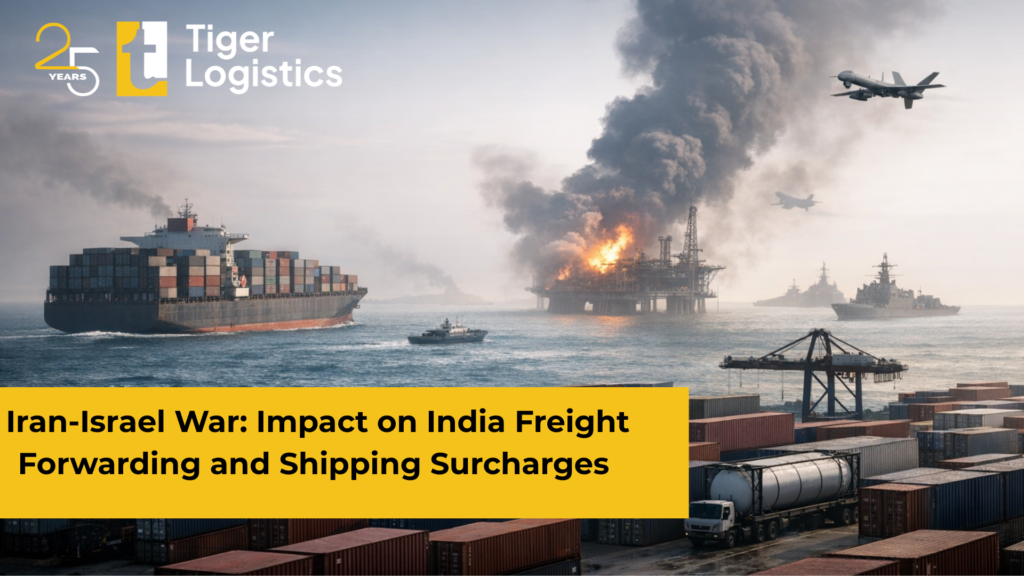
The escalation of the Iran-Israel conflict in early March 2026 has triggered a series of significant operational and financial disruptions across India’s export and import freight ecosystem. Shipping lines, port authorities, and freight forwarding companies operating ex-India have been navigating a rapidly evolving situation as geopolitical tensions in the Middle East continue to affect global trade routes.
Surcharges Introduced Across Major Shipping Lines
Following the reopening of global fuel markets on March 2, 2026, multiple carriers have implemented new emergency surcharges on cargo moving out of India. The charges introduced include:
- Emergency Fuel Surcharge (EFS)
- Emergency Contingency Surcharge (ECS)
- Emergency Equipment Surcharge (EIS)
- War Risk Surcharge (WRS)
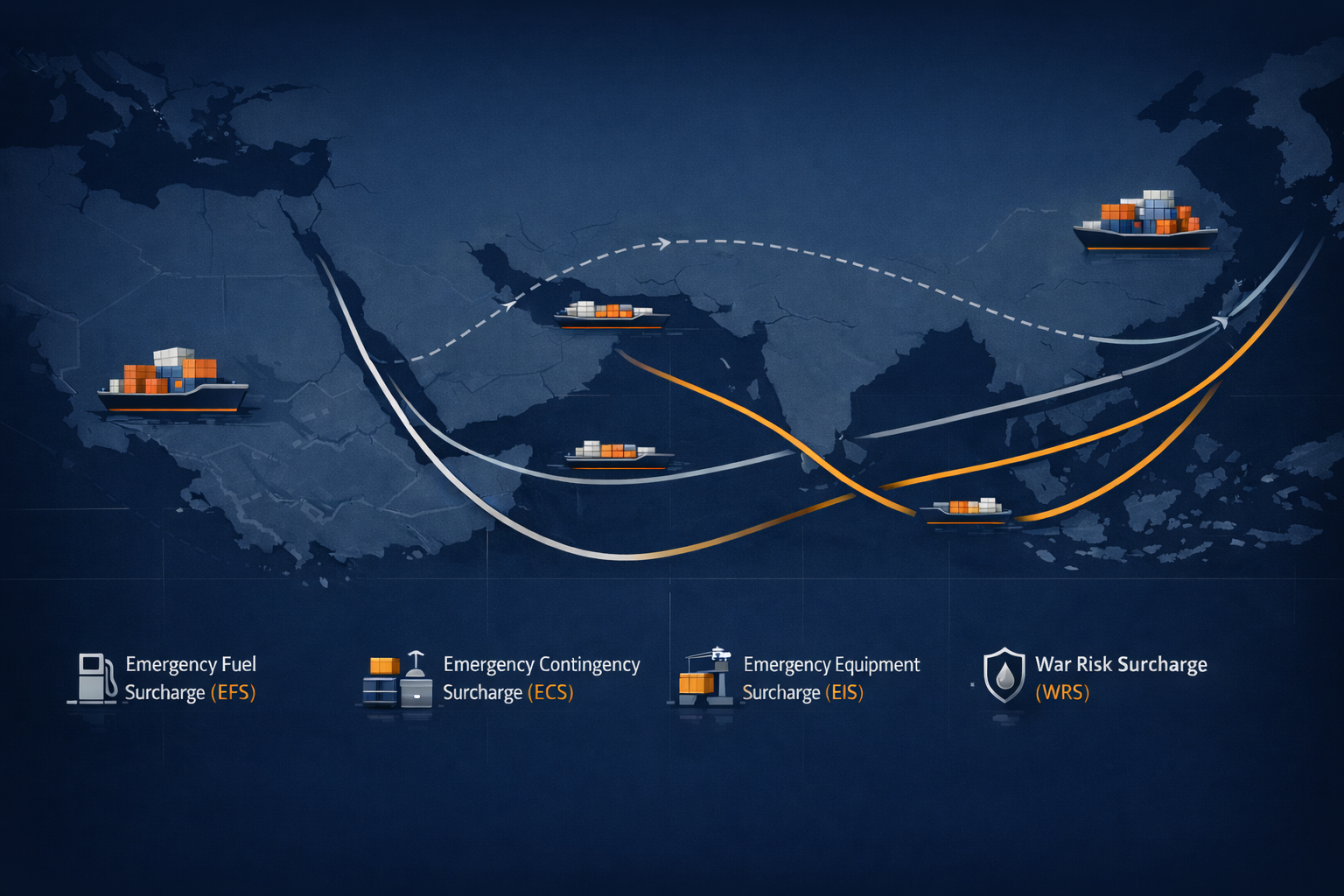
These have been applied with immediate effect across nearly all trade lanes.
| Trade lane | Type of increase | Important Update | Status |
| India → Middle East | War risk surcharge | USD 2,000–3,000 / container | Suspended / restricted |
| India → Europe | Base freight rate | 50% Increase | Significantly up |
| India → Europe | Transit time | +10–20 days (Suez detour) | Delayed |
| All long-haul ex India | Emergency Fuel Surcharge (EFS) | +USD ~1,000 / container | Implemented |
| All trades | Bunker / fuel cost | +USD 10–15 per barrel | Rising |
Sources: Seafood Exporters Association of India (via Deccan Chronicle, March 2026); Mint / CNBC India (India–Europe freight data); industry market advisories. All figures are indicative and subject to change. Please verify with your freight provider for current applicable rates.
Gulf Port Services Suspended
Several carriers have temporarily suspended services to Gulf ports. Affected destinations include all major UAE ports except Khor Fakkan and Fujairah, all major Bahrain ports, Iraq’s Port of Umm Qasr, all major Saudi Arabian ports except Jeddah and King Abdullah Port, all Kuwait ports, and all major Qatar ports.
Carriers have also declared “end of voyage” on select sailings, meaning containers will be diverted to safe alternative ports at the expense of individual shippers.
Current Situation at Ports
At India’s busiest container port, the numbers tell the story. Around 5,000 containers were stuck at Jawaharlal Nehru Port Authority (JNPA) as of March 1 many of them perishables with a ticking clock.
The Ministry of Ports, Shipping and Waterways stepped in with a formal directive to all major ports, and JNPA moved quickly setting up a dedicated task force and naming a single point of contact to cut through the coordination bottleneck.
On the ground, the port rolled out a series of practical measures: extra storage for Middle East-bound cargo, ad-hoc vessel calls to ports east of the Strait of Hormuz — including Fujairah, Khor Fakkan, Sohar, Muscat, Salalah and a waiver of fees and inspection requirements to speed up the return of containers to exporters. Notably, cargo was also permitted to move back without the usual Export General Manifest filing, a procedural flexibility that under normal circumstances would not be on the table.
Staying ahead of the curve
Global trade has always been vulnerable to geopolitical events, and the current situation is a reminder of just how quickly things can shift. If you have shipments scheduled to the Middle East or on lanes transiting through the region, it is worth speaking to your freight partner sooner rather than later — whether that means exploring alternative routes, reviewing your cargo insurance cover, or simply understanding what surcharges apply to your specific trade lane. For perishable or time-sensitive cargo, early communication is especially critical. No two shipments are the same, and the right course of action will depend on your cargo type, destination, and timeline. Stay in close contact with your logistics provider, keep an eye on port advisories, and build some extra lead time into your planning until the situation stabilizes.